As brands expand into new markets, maintaining consistency while adapting to local conditions becomes increasingly complex. The most successful rollout programs are built on more than design standards alone, requiring a coordinated strategy that supports efficient decision-making, predictable execution, and long-term scalability. This series examines the foundational elements that help brands grow with confidence.
In Part 1 of this series, we explored the importance of establishing a scalable growth strategy built on a deep understanding of the client’s business objectives, decision-making processes, and operational priorities. The next step is building a support structure capable of translating those objectives into consistent execution at scale.
As programs expand, complexity increases exponentially. What begins as a handful of projects can quickly evolve into dozens of active sites moving simultaneously through real estate, entitlement, design, permitting, and construction. Each location introduces additional partners, consultants, contractors, landlords, and jurisdictional reviewers. Without the right support structure, communication bottlenecks and coordination challenges can slow momentum.

David Drouhard draws on decades of national rollout experience across restaurant, retail, and grocery programs, emphasizing that successful expansion depends on trusted advisor relationships, consistent execution across teams, and proactive communication.
A key part of that structure is establishing clear accountability. Clients need a trusted leader who understands the program, coordinates resources, and ensures questions are answered quickly and consistently. At Galloway, that often means assigning a dedicated program lead who serves as the primary point of contact, providing a single source of accountability while coordinating communication and resources across all disciplines.
At the same time, successful rollout programs require more than a single relationship. As programs expand across multiple markets and regions, clients benefit from having access to a broader team that understands their goals, standards, and processes.
This approach provides the best of both worlds: a dedicated leader who quarterbacks the program and a team structure that delivers continuity, responsiveness, and scalable support as growth accelerates. Critical knowledge is embedded across the team rather than concentrated with one individual, providing continuity when workloads shift, personnel change, or new projects launch simultaneously. Brands gain confidence that support remains consistent and responsive regardless of program size.
To sustain that alignment over time, successful programs also create intentional opportunities to step back and evaluate performance and relationship health at a portfolio level. Annual business reviews provide a structured forum to assess trends, review metrics, identify improvements, and align future goals.
“Many firms can perform a site adapt, but it’s about becoming strategic with the client to build their program for longevity,” says David Drouhard, regional architectural team manager and senior associate at Galloway.
The strongest relationships evolve beyond project delivery and become long-term partnerships focused on sustainable growth.
One of the greatest challenges in multisite expansion is maintaining consistency while continuing to grow quickly. Customers expect the same brand experience regardless of location. Investors expect predictable results. Internal teams need confidence that standards will hold as the program scales. Achieving that consistency requires far more than repeating a prototype.
Successful brands build repeatable systems supported by standardized processes, rigorous quality control, and continuous training. Templates, workflows, and design frameworks create a consistent foundation that allows teams to move efficiently from site to site while reducing opportunities for errors.
While this can appear straightforward on paper, the opposite is often true in execution. As programs scale, small variations in design interpretation, local code requirements, or coordination timing can quickly multiply across dozens of locations. Consistency in brand experience is the result of disciplined management.
Fast delivery is often seen as the primary goal of brand rollout programs, but speed is the outcome of preparation rather than shortcuts. Programs move quickly when teams are aligned, expectations are clearly defined, and systems have been refined through repetition.
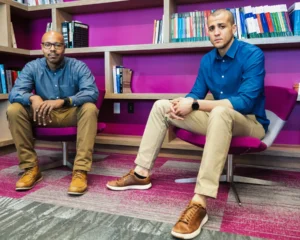
Ray Stubblefield alongside Blake Olson, regional architectural team manager and principal at Galloway. Their work reflects the coordination and attention to local requirements that supports efficient rollouts across markets.
Maintaining that level of performance requires ongoing investment in both people and processes. As prototypes evolve, teams must stay aligned with updated standards, operational requirements, and brand priorities. Strong quality control becomes especially important in this environment because even small oversights can scale into significant cost, delay, or rework across multiple sites.
Experienced reviewers play a key role in this process. They ensure that each project meets client standards while also responding to local regulations before documents move into permitting and construction.
“You must be very intentional about digging into the code and getting into the weeds with local requirements,” says Ray Stubblefield, senior architectural project manager and senior associate at Galloway. “It is not something you can assume carries across from city to city or state to state.”
The most successful expansion programs recognize that consistency and flexibility are not competing goals. They are interdependent. Standardization creates efficiency and predictability, while thoughtful adaptation ensures each individual site succeeds within its local context.
When both are managed well, repeatable work becomes predictable work, allowing brands to expand with greater confidence, reduce risk, and sustain quality across every new market.
Successful brand expansion is not about delivering a single project. It is about creating a repeatable system that supports growth across dozens or hundreds of locations while maintaining quality, speed, and brand consistency.
Galloway’s Full Spectrum Approach™ brings together the collective knowledge and experience of multiple disciplines from the outset, creating a collaborative environment where opportunities and challenges are identified early, communication is streamlined, and solutions are developed proactively.
By combining cross-disciplinary insight, local market knowledge, and decades of national program experience, Galloway helps brands reduce risk, accelerate delivery, and scale with confidence.
Whether supporting regional growth initiatives or nationwide expansion programs, our goal remains the same: helping clients move faster, make better decisions, and build programs designed for long-term success.
We are nationally recognized and locally preferred. We would love to work with you on your next project.
Contact Us