When many people think of interior design, they imagine finishes, furniture, and final touches. In the AEC industry, however, interior design plays a far more critical role. It directly impacts how a space functions, performs, and ultimately serves the people who use it.
“We work to design a space that is aesthetically pleasing but also meets the needs and wants of the end user. We consider space planning, lighting, material durability, acoustics, workflow, and more,” says Emily Oberrieder, interior designer at Galloway.
Interior design is a strategic discipline that bridges aesthetics, technical performance, and human experience, bringing value from the earliest planning stages through final occupancy.
Interior design starts with understanding how a space needs to work. Through needs assessments and programming, our team collaborates closely with clients and user groups to define space requirements, operational workflows, and future growth.
“For an office, for example, we will ask how many offices and workstations are needed, what projected growth looks like, what ancillary spaces are needed, shared conference rooms and training spaces,” says Annette Coleman, an interior design manager at Galloway.
From there, those needs are translated into tangible metrics by determining an appropriate building size, evaluating square footage requirements, and aligning them with real-time construction cost data. We develop a holistic project budget that considers construction, furniture, technology, AV systems, and other soft costs essential to a fully functional space.
The result is a clear, data-driven roadmap that defines building size, budget expectations, and spatial priorities. This foundation enables a confident transition into programming and detailed space planning.
Space planning is where strategy becomes tangible. It is not simply about fitting people into a building. It is about aligning the physical environment with how an organization operates day to day while also shaping how that space is experienced.
Experienced interior design professionals evaluate adjacencies, workflow patterns, and shared space opportunities to create layouts that improve efficiency and reduce friction. Departments that frequently collaborate are positioned intentionally, circulation paths are intuitive, and shared resources such as conference rooms, training areas, and support spaces are placed to maximize use while minimizing wasted square footage.
In many cases, thoughtful space planning can reduce overall building size or eliminate underutilized areas, delivering measurable cost savings without sacrificing performance.
Interior design operates at the intersection of performance and perception. A well-designed space not only functions, but feels intuitive to the people using it.
“If you go into a Cajun restaurant and you don’t have to guess where to go for the hostess, where to sit, or where the restrooms are, and you feel like you are in Louisiana, then we did our job. We make that experience effortless for users,” says Hoshi Brooks, Galloway senior interior design manager and principal.
That sense of ease is not accidental. It is shaped by highly technical decisions embedded in space planning and design execution. Lighting strategies balance natural and artificial sources to support visibility, comfort, and energy performance. Acoustics are designed to control sound transfer and support the intended use of a space, whether focused work, collaboration, or high-security operations. Material selections influence not only aesthetics, but also durability, cleanability, and long-term maintenance.
“It’s all the small details that really bring a space together, elevate it, and evoke a feeling,” says Emily.
Interior designers also play a key role in helping clients visualize what is possible. Many clients come with ideas but not a clear understanding of how those ideas translate into space, cost, or feasibility.
“We have a deep 3D understanding of the space. We use vision boards, material palettes, and digital renderings to help clients understand how their vision will come to life,” says Katie.
By aligning vision with reality early, we reduce costly revisions and help projects move forward with clarity and confidence.
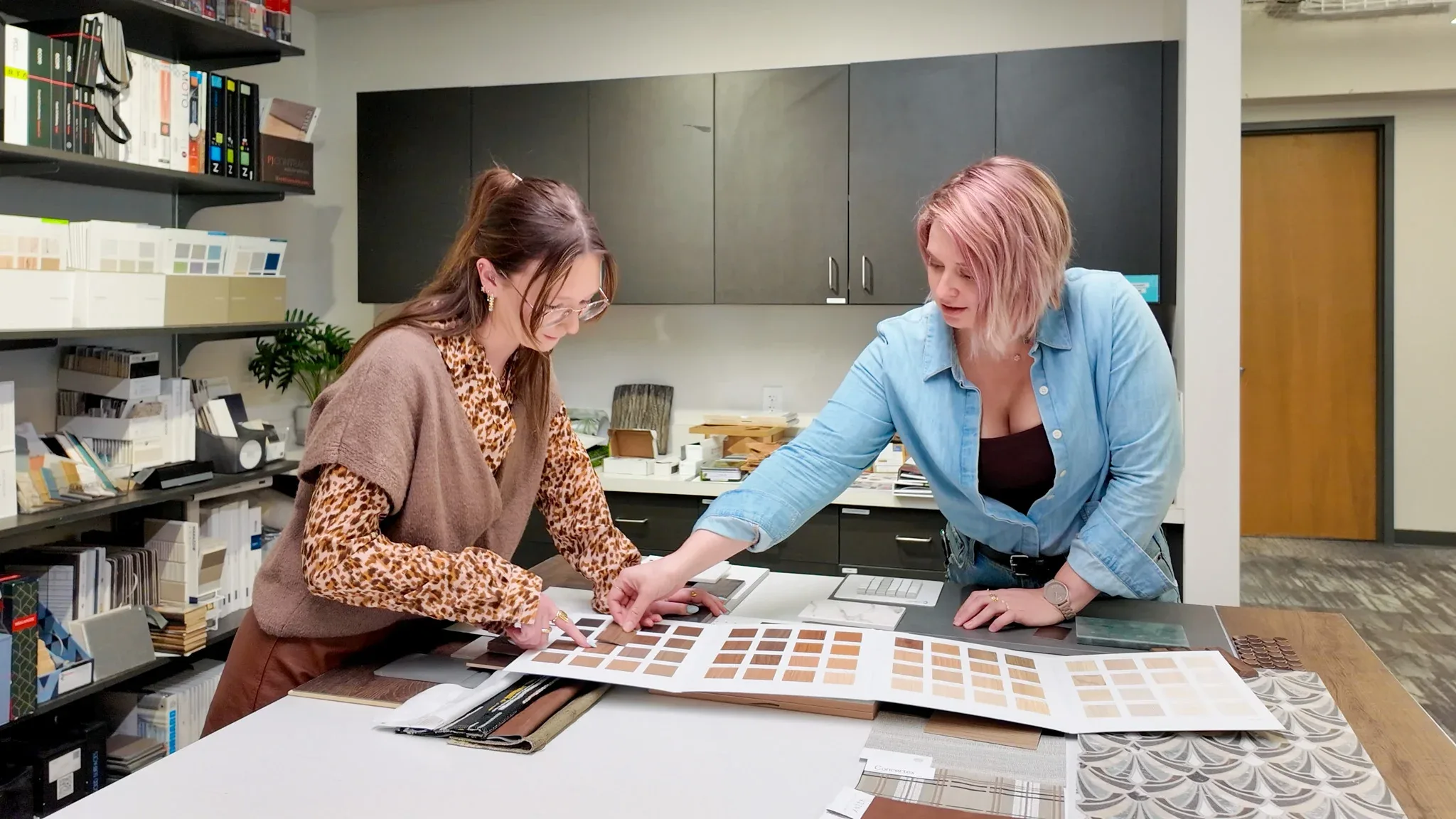
Interior Designers Nicole Desjardins and Emily Oberrieder work on creating a materials palette for a hospitality project.
Interior design is deeply integrated within the technical framework of a project. Our team develops detailed construction documents, coordinates engineering systems, and ensures compliance with building codes, accessibility standards, and life safety requirements.
Material selection is a critical part of this process. Each product is evaluated based on durability, maintenance requirements, safety, and suitability for the environment.
“You might think you can just pick materials from consumer retail sources, but there is a major difference in product quality, warranties, and construction methods,” says Hoshi.
Initial costs can sometimes feel high, especially when clients consider simpler options like paint. However, when durability and long-term maintenance are considered, higher-quality materials often result in significant lifecycle savings.
“For example, healthcare environments require materials that support infection control and are easy to disinfect, while high-traffic municipal facilities demand finishes that can withstand years of use,” adds Katie Zerr, project interior designer at Galloway.
By addressing these considerations early and in coordination with the broader design team, we help reduce change orders, avoid field conflicts, and ensure the final built environment performs as intended.
Interior design is most effective when it does not happen in isolation but is integrated with architecture and engineering from the very beginning. Our team collaborates closely with in-house and external mechanical, electrical, structural, architectural, and landscape professionals to ensure every system aligns with the overall design intent. This coordination prevents conflicts, improves efficiency, and results in better-performing buildings.
“Everybody has to have the same vision from the start to make sure all of our systems work together, from large-scale space planning down to making sure there is an electrical outlet where a desk goes,” says Annette.
The result is a cohesive, fully coordinated environment where every element supports the end user.
Whether you are planning a new facility, renovating an existing space, or exploring what is possible, engaging an interior design team early can significantly improve outcomes. At Galloway, our interiors team partners with clients across industries to deliver spaces that are functional, durable, and thoughtfully designed, aligned with both immediate needs and long-term goals. No project is too small. From furniture selection to full-scale new construction or renovation, we are ready to help shape what comes next.
We are nationally recognized and locally preferred. We would love to work with you on your next project.
Contact Us