Engineering in mountain terrain involves steep slopes, unpredictable soils, harsh weather, and small-town governance, all of which make development uniquely complex. Over the past 40 years, Galloway has grown from its Colorado roots, expanding into Utah in 2013. Today, the firm operates nationwide, with seven of its 16 offices located across the two states and supporting dozens of projects throughout the Rocky Mountains.
Designing in mountain communities requires a deep understanding of elevated terrain, where freeze-thaw cycles, steep slopes, wildfire exposure, and highly variable surface conditions fundamentally shape design approaches, infrastructure performance, and long-term resilience.

From full service architecture to engineering services, Galloway is developing this 350-acre ranch in Colorado’s mountains with durability and natural preservation in mind.
Mountain terrain is subject to freeze-thaw cycles that affect temperature-sensitive materials such as concrete, asphalt, brick, and stone. The repeated expansion and contraction of these materials during freeze-thaw cycles accelerates surface deterioration, making durable material selection and lifecycle planning critical for long-term performance.
“We help clients understand how surface finishes will behave over time to determine the right option for their project,” says Kyle Pollock, civil engineering project manager and senior associate at Galloway. “We also present alternatives, such as adding extra stormwater inlets to capture surface water before it becomes ice, improving long-term surface performance and safety for pedestrians and vehicles.”
Proper drainage and erosion control are critical in mountain environments, where steep terrain and rocky soils heighten the risk of flash flooding, mudslides, and impacts to mountain streams. Designs must carefully manage how water moves across the site while protecting downstream resources.
Fire mitigation planning, including defensible space strategies and resilient material selection, also helps reduce post-fire flooding and erosion risks. Our teams verify utility capacity early, particularly water supply for fire protection systems, and plan solutions where infrastructure is limited.
Designers must also balance evolving water quality requirements with preservation of the natural landscape. On steep sites, this often makes detention and slope stabilization particularly challenging and requires creative, site-specific solutions.
“We help clients identify solutions for hazard evaluations such as landslide zones, avalanche paths, and fire-prone areas,” says Chris Pauley, water resources team manager and associate at Galloway. “Sometimes a bigger size of service for sprinkler systems is needed or creating defensible space. Whether it is or isn’t in the codes, we can provide input.”
Design should follow natural contours wherever possible to minimize grading, retaining walls, and construction costs while reducing environmental disturbance. Preserving view sheds and mountain vistas is equally important, ensuring development enhances the experience for residents and visitors rather than detracting from it.
“We work to accentuate or highlight existing features to make the design and construction as simple as possible while retaining the natural feel,” says Kyle.
Projects must also anticipate evolving federal and local requirements while protecting the pristine character of mountain waterways. Successful designs work with existing site features to maintain the natural appeal that defines mountain communities.
Deeper frost depths in mountain environments often require utilities to be buried deeper than typical installations, increasing the likelihood of encountering bedrock or large boulders. Subsurface conditions can also vary dramatically over short distances, with frequent transitions between bedrock, sand, and gravel. This variability demands close field coordination to resolve issues as they arise and flexible design approaches such as creative utility alignments.
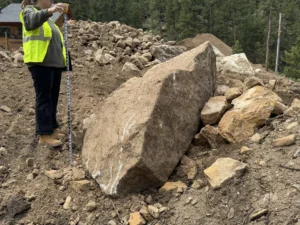
This large boulder, excavated during construction in Estes Park, Colorado, illustrates a common challenge when developing in mountain terrain.
Designing in mountain communities often means working within existing conditions and limited room for new development. As a result, teams must contend with aging or smaller-scale infrastructure that requires evaluation and upgrades. Legacy improvements can cross property lines based on long-standing informal agreements. While this system and infrastructure may have functioned for decades, new projects can trigger the need to reassess conditions, bring systems up to code, and sometimes redesign elements.
Growth pressures can further amplify these issues. For example, a seemingly viable project may be constrained by a decades-old 12-foot-wide bridge that cannot support increased traffic or emergency access. Even modest population or housing increases can significantly strain utilities, road networks, and emergency access in small mountain communities. As a result, it’s crucial to modernize infrastructure and align with current land use and engineering standards as efficiently as possible.
Mountain towns often have less prescriptive development codes, making strong relationships with local staff essential for interpreting intent and navigating approvals. Variances are more common due to steep grades, geologic hazards, and legacy conditions, but they require careful justification and sound judgment to avoid compromising safety or setting problematic precedents.
For example, a site constrained by a geologic hazard area may lose a significant portion of its buildable footprint, prompting teams to negotiate modest parking reductions to avoid excessive retaining walls. Similarly, a roadway governed by a 10% maximum grade may be difficult to construct where existing terrain pushes access closer to 15%.
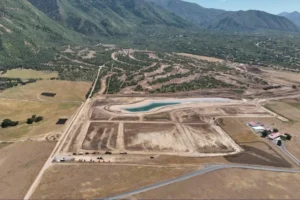
Under construction in Utah’s rugged terrain, this residential community features a debris basin to manage runoff and reduce mudslide risk, along with optimized roadway grading for safer access along the Wasatch slopes.
Because many mountain markets are served by a small network of repeat consultants and stakeholders, successful projects also depend on proactive community engagement, including town halls and early communication with local departments.
At the same time, workforce housing has become a growing priority in many mountain communities, particularly in ski towns across the U.S. and in Colorado, where rising housing costs have contributed to significant staffing shortages. Jurisdictions sometimes tie employee housing requirements to new development, with some hotel and commercial projects required to dedicate units to workforce housing or support off-site solutions.
Ultimately, success in mountain entitlements comes down to rigorous due diligence and early feasibility analysis. Teams must understand where flexibility may be appropriate and where constraints are absolute. Identifying these factors early helps projects avoid
We share these insights because success depends on more than technical knowledge alone. With project experience, the right tools, and local connections, our teams help clients navigate challenging terrain and design resilient infrastructure that lasts. When your next mountain project requires professionals you can trust, Galloway is ready to help.
We are nationally recognized and locally preferred. We would love to work with you on your next project.
Contact Us