TDM programs provide tenants with increased mobility choices and enhanced access to the property, help developers reduce parking construction costs and attract tenants with transportation amenities, and enhance the quality of life in the surrounding neighborhood by reducing vehicular traffic. The Galloway TDM team was pleased to have collaborated with the first development in the City of Charlotte to submit a TDM Work Plan to the City of Charlotte for review and approval.
Transportation Demand Management (TDM) is a set of strategies that influence travel behavior by mode of transportation, frequency, time, route, or trip length to reduce single-occupancy vehicle (SOV) trips. To put it another way, TDM programs ease demand for existing transportation infrastructure by expanding the transportation choices available to commuters and tenants at individual properties and within the cities that surround them.
Many cities around the United States require a TDM Plan from new real estate developments that are expected to have a significant impact on traffic congestion in the communities that surround them. A TDM Plan demonstrates that a development is committed to reducing its impact on traffic congestion and how it will do so. Typically, a TDM plan includes a list of on-site amenities that will encourage tenants to walk, bike, carpool, or use public transportation for their daily activities.
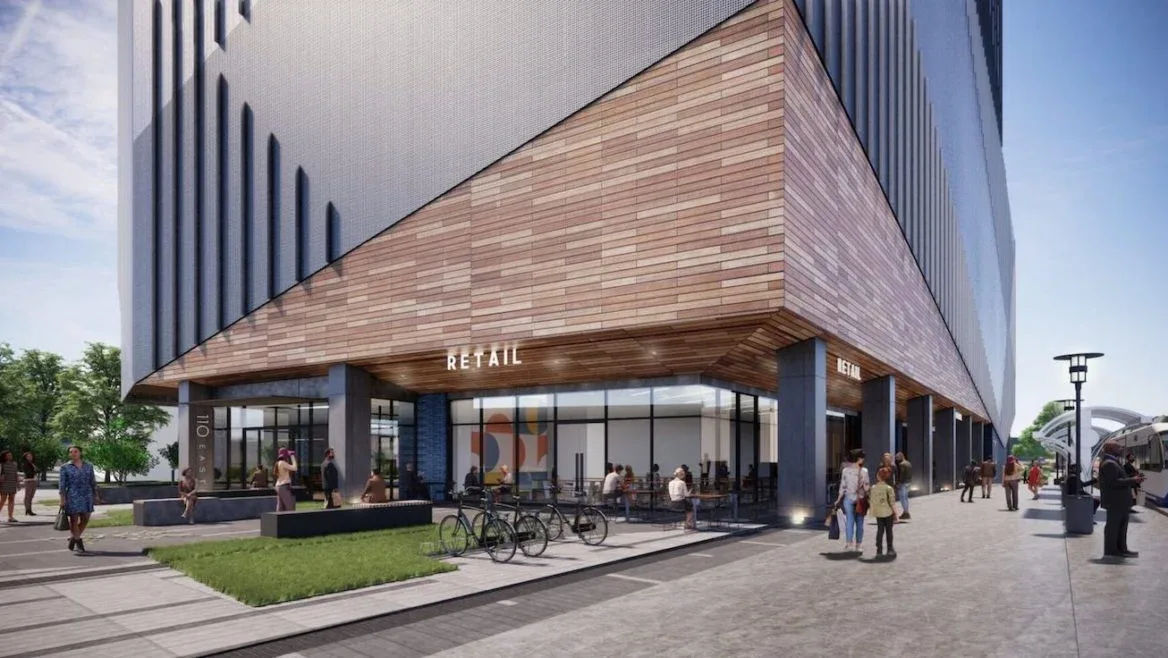
110 East is located along East Boulevard in the South End neighborhood of Charlotte, North Carolina. Development team Stiles and Shorenstein have plans for the site to include a new 23-story office tower containing approximately 370,000 square feet (S.F.) of Class A+ office space, which includes ground-floor retail uses. Access to and from the site is provided via driveways along East Boulevard and South Boulevard.
The South End neighborhood of Charlotte is a vibrant mixed-use area just south of Uptown. The LYNX Blue Line traverses the neighborhood and provides easy access into center city and other points of interest in the region. Other shared mobility options in the site’s vicinity include bikeshare, scooter-share, and carshare options. Additionally, this area of the city is benefiting from the ongoing development of numerous mixed-use transit-oriented projects, as well as infill development, which are increasing the density of the neighborhood and changing its character to an urban center that naturally promotes multimodal transportation choices.
As described in the approved development conditions agreed upon by the Applicant and City of Charlotte staff, the Transportation Demand Management (TDM) Work Plan will require items at 110 East such as:
The plan includes basic and supplemental components; basic components meet the TDM conditions of development requested by CDOT and deliver minimum TDM program standards, while supplemental components are considered best practices for delivering optimally performing TDM programs. 110 East will implement strategies to support a non-auto mode share reduction of 30%, or approximately 1,500 weekday vehicular trips, which was assumed in the site’s Traffic Impact Study. Meeting mode share reduction goals is critical to achieving manageable traffic operations, vehicular queues, and projected parking demand.
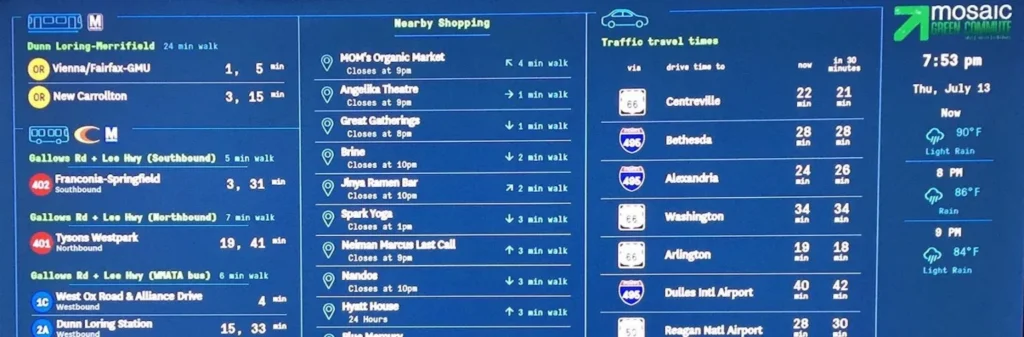
Real-time transit information screens at the property will improve tenants’ use and access to a wider range of transportation options.
A typical TDM plan outlines a list of infrastructure and program/service strategies that a site will offer. Although these plans outline what strategies will be deployed, they often do not delineate the steps required to implement them, when to implement them, or the costs of implementing them. The result is that the team responsible for site operations is usually not well enough informed about how to cost-effectively launch a TDM program at its property.
In our experience, the person who is responsible for implementing a TDM Plan is often a property manager who was not involved in the development of the plan, nor are they trained in how to execute TDM strategies.
With our experience implementing TDM plans at dozens of properties, our mobility management team designs TDM plans that include step-by-step actions to implement each strategy along with a corresponding budget, timeline, and milestones, to ensure they are cost-effectively operational by the time tenants occupy the property. Our TDM team applied this philosophy to the 110 East TDM plan, which includes the following elements that go beyond CDOT requirements:
The 110 East project was the first development in the City of Charlotte to submit a TDM Work Plan to the Charlotte Department of Transportation (CDOT) for review and approval. Other noteworthy developments in the city, like Ballantyne and the expansion of Atrium Health at the Carolinas Medical Center, are also required to submit a TDM Work Plan.
The trend of large developments committing to TDM strategies is likely to continue given that TDM is a significant component of the mobility goals outlined in the latest draft of Charlotte’s Future 2040 Comprehensive Plan.
We are nationally recognized and locally preferred. We would love to work with you on your next project.
Contact Us